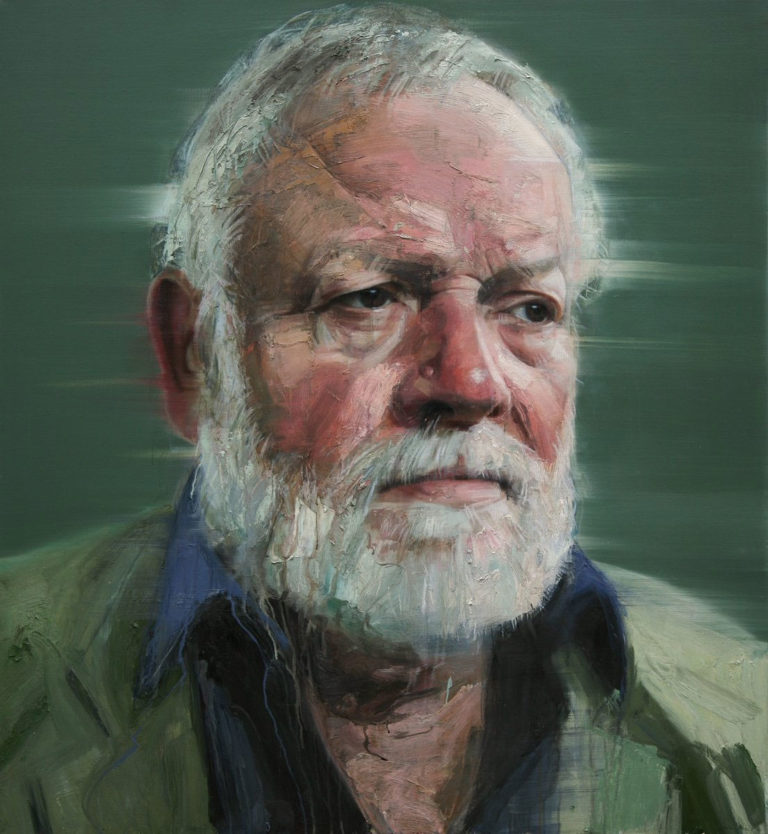
To reassert the liveliness of ordinary things, precisely in the face of what is hardest and most broken in life and society — this has been Michael Longley’s gift as one of Northern Ireland’s foremost living poets. He is known, in part, as a poet of “the Troubles” — the violent 30-year conflict between Protestants and Catholics, English and Irish. And he is a gentle voice for all of us now, wise and winsome about the everyday, never-finished work of social healing.
Poets & Poetry
This collection offers episodes and writings from the archive dating back to 2003. To listen to more poems and search our ever-expanding archive, visit our new home for poetry.
View
- List View
- Standard View
- Grid View
65 Results
Filters
It’s pretty intriguing to follow poet Naomi Shihab Nye’s idea that most of us actually “think in poems” whether we know it or not. Rarely, as she points out, do you hear anyone say they feel worse after writing things down. That, she says, can be a tool to survive in hard times like these, to anchor our days and to get into a conversation and community with all of the selves that live on in each of us at any given moment — “your child self, your older self, your confused self, your self-that-makes-a-lot-of-mistakes.” We also hear her read her beloved poem “Kindness” and tell us the story behind it.
December 17, 2020
Jennifer Michael Hecht
‘We Believe Each Other Into Being’
“We are indebted to one another and the debt is a kind of faith — a beautiful, difficult, strange faith. We believe each other into being.” That’s the message the philosopher, poet, and historian, Jennifer Michael Hecht, puts at the center of her unusual writing about suicide. She’s traced how Western civilization has, at times, demonized those who died by suicide, and, at times, celebrated it as a moral freedom. She has struggled with suicidal places in her life and lost friends to it. She proposes a new cultural understanding based on our essential need for each other.
The Cuban American civil engineer turned writer, Richard Blanco, straddles the many ways a sense of place merges with human emotion to make home and belonging — personal and communal. The most recent — and very resonant — question he’s asked by way of poetry is: how to love a country? At Chautauqua, Krista invited him to speak and read from his books. Blanco’s wit, thoughtfulness, and elegance captivated the crowd.
The poet Jericho Brown reminds us to bear witness to the complexity of the human experience, to interrogate the proximity of violence to love, and to look and listen closer so that we might uncover the small truths and surprises in life. His presence is irreverent and magnetic, as the high school students who joined us for this conversation experienced firsthand at the 2018 Geraldine R. Dodge Poetry Festival. And now he’s won the 2020 Pulitzer Prize for Poetry.
Editor’s note: This interview discusses sexual violence and rape.
September 24, 2020
‘Poetry Unbound’ Returns, With Wisdom For Living Now
Poetry rises up in human societies in times of crisis when official words fail us and we lose sight of how to find our way back to one another; how to hear each other’s voices. This week we offer a preview of the next season of our Poetry Unbound podcast, which returns on Monday, Sept. 28. Each episode takes a single poem as its center, with host Pádraig Ó Tuama reading the poem and meditating on it. In this hour, we dwell with six poems that accompany the struggle, strangeness, and possibilities of being alive in this time.
Subscribe to Poetry Unbound on Apple Podcasts, Spotify, Google Podcasts, Overcast, or wherever you listen.
Marilyn Nelson is a storytelling poet. She has taught poetry and contemplative practice to college students and West Point cadets. She brings a contemplative eye to ordinary goodness in the present and to complicated ancestries we’re all reckoning with now. And she imparts a spacious perspective on what “communal pondering” might mean.
We often explore on this show the places in the human experience where ordinary language falls short. The poet Gregory Orr has wrested gentle, healing, life-giving words from extreme grief and trauma. And right now we are all carrying some magnitude of grief in our bodies.
April 16, 2020
Wendell Berry and Ellen Davis
The Art of Being Creatures
In this intimate conversation between Krista and one of her beloved teachers, we ponder the world and our place in it, through sacred text, with fresh eyes. We’re accompanied by the meditative and prophetic poetry of Wendell Berry, read for us from his home in Kentucky: “Stay away from anything / that obscures the place it is in. / There are no unsacred places; / there are only sacred places / and desecrated places. / Accept what comes of silence.”
In Leanne O’Sullivan’s poem “Leaving Early,” the poet writes to her ill husband, entrusting him into the care of a nurse named Fionnuala. As the novel coronavirus sweeps the globe, many of us can’t physically be there for loved ones who are sick. Instead, it is the health care workers — and all involved in the health care system — who are tirelessly present, caring for others in spite of exhaustion and the risk it brings to their own wellbeing.
We offer this episode of Poetry Unbound in profound gratitude toward all who are working in health care right now.
Emily Dickinson’s poem “1383” honors the friendships that endure across time, circumstance, and even misunderstanding. Akin to fire, the connections in these friendships may be strong enough to burn or hurt us, but Dickinson acknowledges that their light continues to draw us in regardless.
After listening, we invite you to reflect on this question: Think about a friendship that has remained steady for you across the years, even as both of you have changed. Why do you think your relationship has endured?
Raymond Antrobus’s poem “Miami Airport” bears witness to the disempowerment that comes when you’re not believed. The voice of the poet is absent, and all we hear is an interrogator seeking to disrupt and displace. This space of suspicion creates anxiety, transporting us to the places and times when someone has questioned the truth of our story.
A question to reflect on after you listen: When have you felt disempowered by questions about yourself? Did you find your voice again? How?
Patrick Kavanagh’s poem “The One” is about seeing beauty in the ordinary places of home. One of Ireland’s most famous poets, Kavanagh grew up in rural County Monaghan and moved to Dublin as a young man. This poem revisits the boglands of his home, which he once hated but came to love.
A question to reflect on after you listen: Think about where you’re from. How has your understanding of it changed over time?
Ali Cobby Eckermann’s poem “Kulila” insists on remembering as a moral act. Through the poem, the Aboriginal poet mourns the loss of Indigenous cultures in Australia and how they have been damaged and changed by colonization. Cobby Eckermann calls her readers to a place of listening and lament as a way to keep alive the memory of who we are and who we could’ve been.
A question to reflect on after you listen: What in your culture or community needs to be lamented, honored, and told?
Kei Miller’s poem “Book of Genesis” asks us to imagine a God who makes things spring into life specifically for us. Just as the poet of Genesis proclaims, “Let there be,” Miller wonders what freedom and flourishing we’d find in imagining a “Let” pronounced not for the person others say we should be, but for the person we are.
A question to reflect on after you listen: How can you begin to let yourself flourish today, just as you are?
Lemn Sissay’s poem “Some Things I Like” celebrates what we might consider discardable — like cold tea, ash trays, and even people. Raising a joyous toast to the forgotten and the forgettable, Sissay recognizes the power we give to what we pay attention to and invites us to look anew at all that has been undervalued.
A question to reflect on after you listen: What is something you like that others may not value in the same way?
Joy Harjo’s poem “Praise the Rain” makes space to appreciate all the nuances of our lives. Echoing Rumi’s poem “The Guest House,” she asks us to be present to this moment — the crazy or the sad, the beginning or the end — to greet it all with the powerful word: “Praise.”
A question to reflect on after you listen: What can you praise today?
An everyday task reveals what is made and unmade in small moments. Ross Gay imagines his fingers opening and closing things, like buttons, the eyes of a dead person, relationships. In doing so, the poem asks us to simply pay attention, today, to what we’re doing with our hands — to understand them as intimate pathways into the stories of our bodies and the stories of our lives.
A question to reflect on after you listen: What have you done with your hands today? What are you opening? What are you closing?
The Pause
Join our constellation of listening and living.
The Pause is a monthly Saturday morning companion to all things On Being, with heads-up on new episodes, special offerings, event invitations, recommendations, and reflections from Krista all year round.
Search results for “”
View
- List View
- Standard View
- Grid View
Filters